4.6 Applied Optimization Problems
Coming Concepts
-
•
Set up and solve optimization problems in several applied fields.
One common application of calculus is calculating the minimum or maximum value of a function. For example, companies often want to minimize production costs or maximize revenue. In manufacturing, it is often desirable to minimize the amount of material used to package a product with a certain volume. In this section, we show how to set up these types of minimization and maximization problems and solve them by using the tools developed in this chapter.
4.6.1 Solving Optimization Problems over a Closed, Bounded Interval
The basic idea of the optimization problems that follow is the same. We have a particular quantity that we are interested in maximizing or minimizing. However, we also have some auxiliary condition that needs to be satisfied. For example, in Example 4.6.1, we are interested in maximizing the area of a rectangular garden. Certainly, if we keep making the side lengths of the garden larger, the area will continue to become larger. However, what if we have some restriction on how much fencing we can use for the perimeter? In this case, we cannot make the garden as large as we like. Let’s look at how we can maximize the area of a rectangle subject to some constraint on the perimeter.
Example 4.6.1 (Maximizing the Area of a Garden).
A rectangular garden is to be constructed using a rock wall as one side of the garden and wire fencing for the other three sides (Figure 4.39). Given ft of wire fencing, determine the dimensions that would create a garden of maximum area. What is the maximum area?
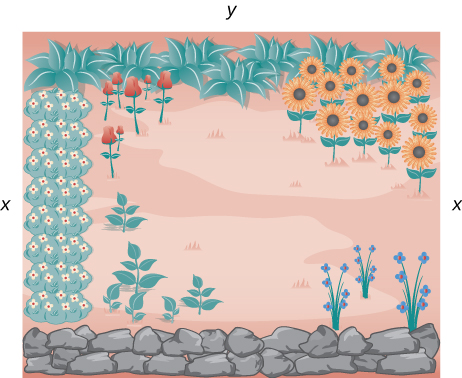
Solution: Let denote the length of the side of the garden perpendicular to the rock wall and denote the length of the side parallel to the rock wall. Then the area of the garden is
We want to find the maximum possible area subject to the constraint that the total fencing is . From Figure 4.39, the total amount of fencing used will be . Therefore, the constraint equation is
Solving this equation for , we have . Thus, we can write the area as
Before trying to maximize the area function , we need to determine the domain under consideration. To construct a rectangular garden, we certainly need the lengths of both sides to be positive. Therefore, we need and . Since , if , then . Therefore, we are trying to determine the maximum value of for over the open interval . We do not know that a function necessarily has a maximum value over an open interval. However, we do know that a continuous function has an absolute maximum (and absolute minimum) over a closed interval. Therefore, let’s consider the function over the closed interval . If the maximum value occurs at an interior point, then we have found the value in the open interval that maximizes the area of the garden. Therefore, we consider the following problem:
Maximize over the interval .
As mentioned earlier, since is a continuous function on a closed, bounded interval, by the extreme value theorem, it has a maximum and a minimum. These extreme values occur either at endpoints or critical points. At the endpoints, . Since the area is positive for all in the open interval , the maximum must occur at a critical point. Differentiating the function , we obtain
Therefore, the only critical point is (Figure 4.40). We conclude that the maximum area must occur when . Then we have . To maximize the area of the garden, let ft and . The area of this garden is .
Checkpoint 4.6.1.
Determine the maximum area if we want to make the same rectangular garden as in Figure 4.40, but we have ft of fencing.
Hint: We need to maximize the function over the interval .
Now let’s look at a general strategy for solving optimization problems similar to Example 4.6.1.
Problem Solving Strategy (Solving Optimization Problems).
-
(a)
Introduce all variables. If applicable, draw a figure and label all variables.
-
(b)
Determine which quantity is to be maximized or minimized, and for what range of values of the other variables (if this can be determined at this time).
-
(c)
Write a formula for the quantity to be maximized or minimized in terms of the variables. This formula may involve more than one variable.
-
(d)
Write any equations relating the independent variables in the formula from step . Use these equations to write the quantity to be maximized or minimized as a function of one variable.
-
(e)
Identify the domain of consideration for the function in step based on the physical problem to be solved.
-
(f)
Locate the maximum or minimum value of the function from step . This step typically involves looking for critical points and evaluating a function at endpoints.
Now let’s apply this strategy to maximize the volume of an open-top box given a constraint on the amount of material to be used.
Example 4.6.2 (Maximizing the Volume of a Box).
An open-top box is to be made from a in. by in. piece of cardboard by removing a square from each corner of the box and folding up the flaps on each side. What size square should be cut out of each corner to get a box with the maximum volume?
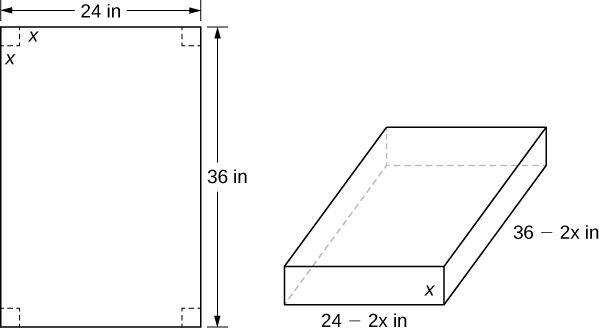
Solution: Step 1: Let be the side length of the square to be removed from each corner (Figure 4.41). Then, the remaining four flaps can be folded up to form an open-top box. Let be the volume of the resulting box.
Step 2: We are trying to maximize the volume of a box. Therefore, the problem is to maximize .
Step 3: As mentioned in step , are trying to maximize the volume of a box. The volume of a box is , where , , and are the length, width, and height, respectively.
Step 4: From Figure 4.41, we see that the height of the box is inches, the length is inches, and the width is inches. Therefore, the volume of the box is
Step 5: To determine the domain of consideration, let’s examine Figure 4.41. Certainly, we need . Furthermore, the side length of the square cannot be greater than or equal to half the length of the shorter side, in.; otherwise, one of the flaps would be completely cut off. Therefore, we are trying to determine whether there is a maximum volume of the box for over the open interval . Since is a continuous function over the closed interval , we know will have an absolute maximum over the closed interval. Therefore, we consider over the closed interval and check whether the absolute maximum occurs at an interior point.
Step 6: Since is a continuous function over the closed, bounded interval , must have an absolute maximum (and an absolute minimum). Since at the endpoints and for , the maximum must occur at a critical point. The derivative is
To find the critical points, we need to solve the equation
Dividing both sides of this equation by , the problem simplifies to solving the equation
Using the quadratic formula, we find that the critical points are
Since is not in the domain of consideration, the only critical point we need to consider is . Therefore, the volume is maximized if we let . The maximum volume is as shown in the following graph.
External Resource.
Watch a video about optimizing the volume of a box.
Checkpoint 4.6.2.
Suppose the dimensions of the cardboard in Example 4.6.2 are 20 in. by 30 in. Let be the side length of each square and write the volume of the open-top box as a function of . Determine the domain of consideration for .
Hint: The volume of the box is .
Example 4.6.3 (Minimizing Travel Time).
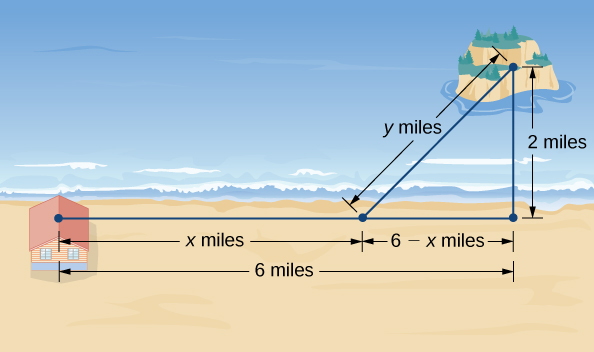
An island is due north of its closest point along a straight shoreline. A visitor is staying at a cabin on the shore that is west of that point. The visitor is planning to go from the cabin to the island. Suppose the visitor runs at a rate of and swims at a rate of . How far should the visitor run before swimming to minimize the time it takes to reach the island?
Solution: Step 1: Let be the distance running and let be the distance swimming (Figure 4.43). Let be the time it takes to get from the cabin to the island.
Step 2: The problem is to minimize .
Step 3: To find the time spent traveling from the cabin to the island, add the time spent running and the time spent swimming. Since Distance Rate Time , the time spent running is
and the time spent swimming is
Therefore, the total time spent traveling is
Step 4: From Figure 4.43, the line segment of miles forms the hypotenuse of a right triangle with legs of length and . Therefore, by the Pythagorean theorem, , and we obtain . Thus, the total time spent traveling is given by the function
Step 5: From Figure 4.43, we see that . Therefore, is the domain of consideration.
Step 6: Since is a continuous function over a closed, bounded interval, it has a maximum and a minimum. Let’s begin by looking for any critical points of over the interval . The derivative is
If , then
Therefore,
| (4.3) |
Squaring both sides of this equation, we see that if satisfies this equation, then must satisfy
which implies
We conclude that if is a critical point, then satisfies
Therefore, the possibilities for critical points are
Since is not in the domain, it is not a possibility for a critical point. On the other hand, is in the domain. Since we squared both sides of Equation 4.3 to arrive at the possible critical points, it remains to verify that satisfies Equation 4.3. Since does satisfy that equation, we conclude that is a critical point, and it is the only one. To justify that the time is minimized for this value of , we just need to check the values of at the endpoints and , and compare them with the value of at the critical point . We find that and whereas . Therefore, we conclude that has a local minimum at .
Checkpoint 4.6.3.
Suppose the island is mi from shore, and the distance from the cabin to the point on the shore closest to the island is . Suppose a visitor swims at the rate of and runs at a rate of . Let denote the distance the visitor will run before swimming, and find a function for the time it takes the visitor to get from the cabin to the island.
Hint: The time .
In business, companies are interested in maximizing revenue. In the following example, we consider a scenario in which a company has collected data on how many cars it is able to lease, depending on the price it charges its customers to rent a car. Let’s use these data to determine the price the company should charge to maximize the amount of money it brings in.
Example 4.6.4 (Maximizing Revenue).
Owners of a car rental company have determined that if they charge customers dollars per day to rent a car, where , the number of cars they rent per day can be modeled by the linear function . If they charge per day or less, they will rent all their cars. If they charge per day or more, they will not rent any cars. Assuming the owners plan to charge customers between $50 per day and per day to rent a car, how much should they charge to maximize their revenue?
Solution: Step 1: Let be the price charged per car per day and let be the number of cars rented per day. Let be the revenue per day.
Step 2: The problem is to maximize .
Step 3: The revenue (per day) is equal to the number of cars rented per day times the price charged per car per day—that is, .
Step 4: Since the number of cars rented per day is modeled by the linear function , the revenue can be represented by the function
Step 5: Since the owners plan to charge between per car per day and per car per day, the problem is to find the maximum revenue for in the closed interval .
Step 6: Since is a continuous function over the closed, bounded interval , it has an absolute maximum (and an absolute minimum) in that interval. To find the maximum value, look for critical points. The derivative is . Therefore, the critical point is When , . When , . When , . Therefore, the absolute maximum occurs at . The car rental company should charge per day per car to maximize revenue as shown in the following figure.
Checkpoint 4.6.4.
A car rental company charges its customers dollars per day, where . It has found that the number of cars rented per day can be modeled by the linear function . How much should the company charge each customer to maximize revenue?
Hint: , where is the number of cars rented and is the price charged per car.
Example 4.6.5 (Maximizing the Area of an Inscribed Rectangle).
A rectangle is to be inscribed in the ellipse
What should the dimensions of the rectangle be to maximize its area? What is the maximum area?
Solution: Step 1: For a rectangle to be inscribed in the ellipse, the sides of the rectangle must be parallel to the axes. Let be the length of the rectangle and be its width. Let be the area of the rectangle.
Step 2: The problem is to maximize .
Step 3: The area of the rectangle is .
Step 4: Let be the corner of the rectangle that lies in the first quadrant, as shown in Figure 4.45. We can write length and width . Since and , we have . Therefore, the area is
Step 5: From Figure 4.45, we see that to inscribe a rectangle in the ellipse, the -coordinate of the corner in the first quadrant must satisfy . Therefore, the problem reduces to looking for the maximum value of over the open interval . Since will have an absolute maximum (and absolute minimum) over the closed interval , we consider over the interval . If the absolute maximum occurs at an interior point, then we have found an absolute maximum in the open interval.
Step 6: As mentioned earlier, is a continuous function over the closed, bounded interval . Therefore, it has an absolute maximum (and absolute minimum). At the endpoints and , . For , . Therefore, the maximum must occur at a critical point. Taking the derivative of , we obtain
To find critical points, we need to find where . We can see that if is a solution of
| (4.4) |
then must satisfy
Therefore, . Thus, are the possible solutions of Equation 4.4. Since we are considering over the interval , is a possibility for a critical point, but is not. Therefore, we check whether is a solution of Equation 4.4. Since is a solution of Equation 4.4, we conclude that is the only critical point of in the interval . Therefore, must have an absolute maximum at the critical point . To determine the dimensions of the rectangle, we need to find the length and the width . If then
Therefore, the dimensions of the rectangle are and . The area of this rectangle is .
Checkpoint 4.6.5.
Modify the area function if the rectangle is to be inscribed in the unit circle . What is the domain of consideration?
Hint: If is the vertex of the square that lies in the first quadrant, then the area of the square is .
4.6.2 Solving Optimization Problems when the Interval Is Not Closed or Is Unbounded
In the previous examples, we considered functions on closed, bounded domains. Consequently, by the extreme value theorem, we were guaranteed that the functions had absolute extrema. Let’s now consider functions for which the domain is neither closed nor bounded.
Many functions still have at least one absolute extrema, even if the domain is not closed or the domain is unbounded. For example, the function over has an absolute minimum of at . Therefore, we can still consider functions over unbounded domains or open intervals and determine whether they have any absolute extrema. In the next example, we try to minimize a function over an unbounded domain. We will see that, although the domain of consideration is , the function has an absolute minimum.
In the following example, we look at constructing a box of least surface area with a prescribed volume. It is not difficult to show that for a closed-top box, by symmetry, among all boxes with a specified volume, a cube will have the smallest surface area. Consequently, we consider the modified problem of determining which open-topped box with a specified volume has the smallest surface area.
Example 4.6.6 (Minimizing Surface Area).
A rectangular box with a square base, an open top, and a volume of in.3 is to be constructed. What should the dimensions of the box be to minimize the surface area of the box? What is the minimum surface area?
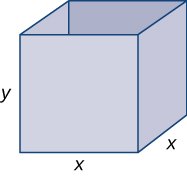
Solution: Step 1: Draw a rectangular box and introduce the variable to represent the length of each side of the square base; let represent the height of the box. Let denote the surface area of the open-top box.
Step 2: We need to minimize the surface area. Therefore, we need to minimize .
Step 3: Since the box has an open top, we need only determine the area of the four vertical sides and the base. The area of each of the four vertical sides is . The area of the base is . Therefore, the surface area of the box is
Step 4: Since the volume of this box is and the volume is given as , the constraint equation is
Solving the constraint equation for , we have . Therefore, we can write the surface area as a function of only:
Therefore, .
Step 5: Since we are requiring that , we cannot have . Therefore, we need . On the other hand, is allowed to have any positive value. Note that as becomes large, the height of the box becomes correspondingly small so that . Similarly, as becomes small, the height of the box becomes correspondingly large. We conclude that the domain is the open, unbounded interval . Note that, unlike the previous examples, we cannot reduce our problem to looking for an absolute maximum or absolute minimum over a closed, bounded interval. However, in the next step, we discover why this function must have an absolute minimum over the interval .
Step 6: Note that as , . Also, as , . Since is a continuous function that approaches infinity at the ends, it must have an absolute minimum at some . This minimum must occur at a critical point of . The derivative is
Therefore, when . Solving this equation for , we obtain , so . Since this is the only critical point of , the absolute minimum must occur at (see Figure 4.47). When , . Therefore, the dimensions of the box should be . and . With these dimensions, the surface area is
Checkpoint 4.6.6.
Consider the same open-top box, which is to have volume . Suppose the cost of the material for the base is and the cost of the material for the sides is and we are trying to minimize the cost of this box. Write the cost as a function of the side lengths of the base. (Let be the side length of the base and be the height of the box.)
Hint: If the cost of material on a side is , the cost of that side is .
Key Concepts
-
•
To solve an optimization problem, begin by drawing a picture and introducing variables.
-
•
Find an equation relating the variables.
-
•
Find a function of one variable to describe the quantity that is to be minimized or maximized.
-
•
Look for critical points to locate local extrema.
Glossary
- optimization problems
-
problems that are solved by finding the maximum or minimum value of a function